
Thought Leadership
by Jochen M. Richter*
Two important events took place over the course of the last 4 weeks that could be seen as being decisive for Ukraine’s future. Therefore, the question arises where are we after the many exchanges at the World Economic Forum in Davos and last weekend’s Munich Security Conference? Has anything changed as soon we are at the sad beginning of the 5th year of Russia’s aggression against Ukraine?
Looking at the brighter elements, there is European readiness to keep up the support for Ukraine. At least by the rhetorics though President Zelensky made clear that he is yet to be convinced that it would be sufficient.
The EU is officially determined to make Ukraine’s membership happen and the Brussels specialists are looking at new formulas that could convince member states to agree despite the still required unanimity.
Furthermore, it arises that no one wants to call the end of NATO. In difference, while everyone confirms at operational level the cooperation continues to work as usual, also the political messages were read as positive signs.
US Secretary of State Rubio’s intervention, by many seen as conciliatory, was met with standing ovations and sighs of relief. The United States have not pulled out from the peace talk as feared earlier by suggesting President Trump getting tired of the missing progress.
Starlink as vital lifeline for Ukrainian military is again an exclusive tool and for now cannot be compromised by Russia. Probably many pray that Elon Musk won’t change his mind.
But despite Canadian Prime Minister Carney’s Davos speech and German Defence Minister Pistorius and Vice-President Kallas clear language in Munich I hear and read too much hope that the cleavage with the US will just be an interim. But is that so?
Yes, indeed the US want to work with Europe but according to their terms. Indeed, they need military installations in Germany to keep up the pressure on Iran as even this President cannot change the physics of our planet earth. But the US message from Munich couldn’t have been clearer though it came in a whisper: our interest is somewhere else than in Europe! The friendly handing over of top NATO leadership positions to Europeans only reinforces this impression.
The US administration pressures Ukraine to deliver more, as President Trump stated, so that his goal for what he considers to be peace can be reached. Whether this is just a fragile ceasefire such as in Gaza is less important.
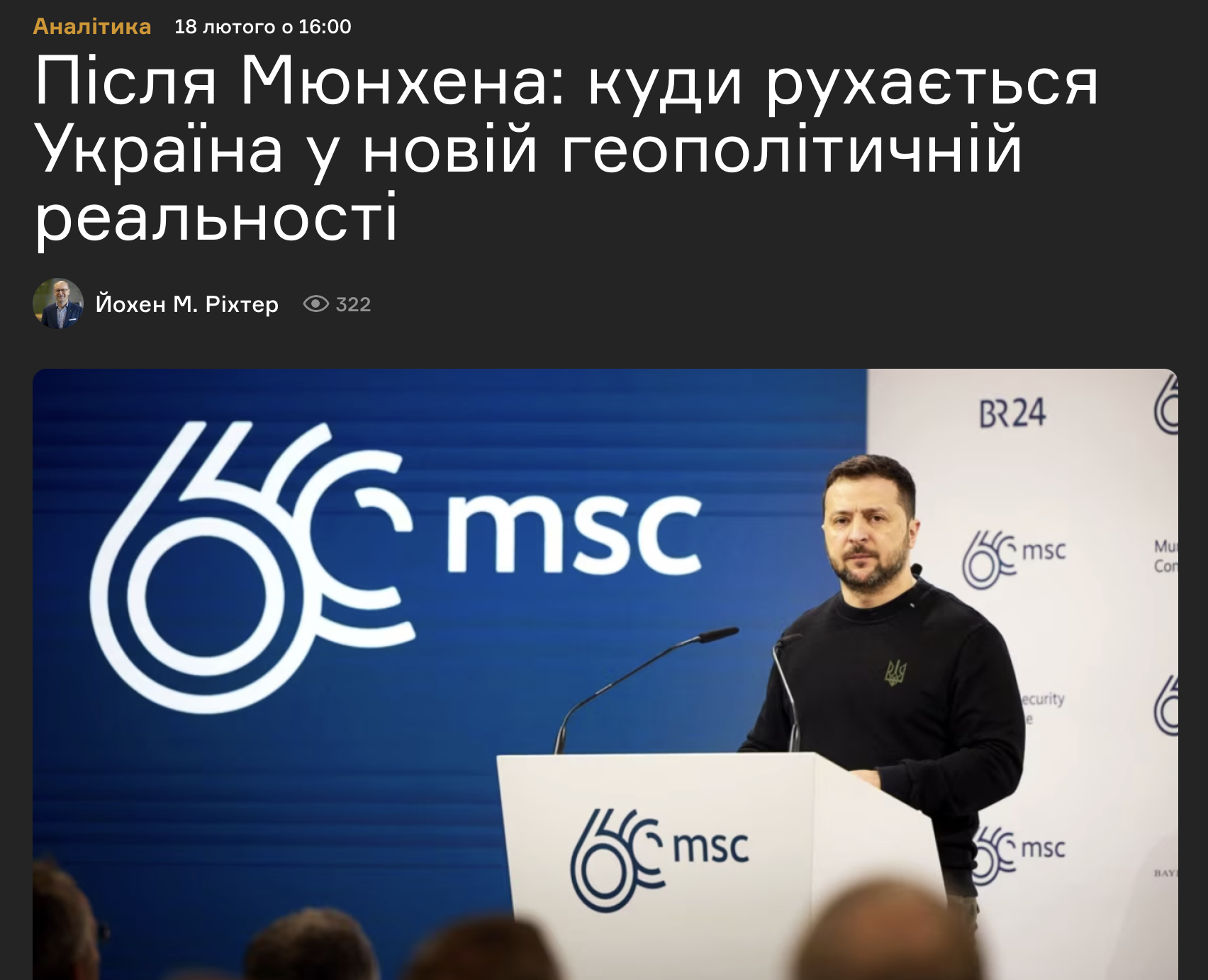
Russia made clear that it continues to contest Ukraine’s sovereignty with its latest twist to call for an international mission to guarantee free elections. I leave aside the daily bombings whose magnitude was demonstrated by President Zelensky’s Munich intervention. On this account I do not recall any US reaction.
Europe’s division in both economic (see Alden Biesen meeting) and military vision between Germany, France, Italy and Poland – just to name the important players – is unfortunately obvious. The missing institutional integration of the UK is yet another weak element.
What would be needed to lend strong support to Ukraine is known by all responsible politicians: closing the gap in capabilities including space, more and better interoperability, strong and protected infrastructure, proven resilience concepts, adaptable mass production capacities rather than stock piling and nuclear protection in addition to US guarantees.
On the latter I dare to add that I find the number crunching ridiculous. We all know the use just of one nuclear war head means disaster for mankind if not worse.
In conclusion, Russia will continue to aggress, pressure and test boundaries, unless being faced with serious European deterrence.
The present US administration wants a deal to be able to concentrate on the main adversary. It won’t offer Europe a choice whether it agrees or not on needs and priorities.
China won’t let Russia crumble and is too successful on several fronts to keep the US at bay.
None of these realities will be different after US mid-terms.
Even in the event of a change in Hungarian leadership much is to be done inside the EU to make the promise of Ukraine’s membership becoming a reality.
One can only hope that not too many politically weak leaders, ideas to put legacy first and too strong national interests stand in the way to do what is needed. The consequences for Europe will be dire and for Ukraine existential.
* Jochen M. Richter is Chair of the Global Security Forum at Diplomatic Council and EU integration lecturer at the Ukrainian Catholic University